Six Sigma Yellow Belt teaches process mapping, basic data collection and root-cause tools so you can actively contribute to, not just observe, a DMAIC improvement project.
Note: Indicative training hours, exact batch schedule confirmed on enrolment.
Note: Reference pricing in INR, select your country above for approximate pricing in your currency.
Note: Average salary is indicative reference data for Yellow Belt-certified professionals, not a guarantee, actual compensation varies by role, industry, employer and location.
Every session is delivered live by an instructor, in English, Hindi or Hinglish, whichever you prefer, there is no self-paced or pre-recorded track.
Overview
Yellow Belt moves beyond vocabulary into practice: you'll learn to map a process, collect basic data on it, and apply simple root-cause tools like the fishbone diagram and 5 Whys.
It's the right starting point for team members who will actively work on a Green Belt-led project, running data collection, documenting the current process, or piloting a small fix, without owning the full statistical analysis.
Who it's for
- Team members actively contributing to a Green Belt or Black Belt-led project
- Frontline supervisors and team leads responsible for local process quality
- Professionals who completed White Belt and want to go further












Curriculum
1Process mapping
- SIPOC diagrams
- Detailed process flowcharts
- Identifying value-add vs. non-value-add steps
2Basic data collection
- Check sheets and data collection plans
- Types of data: continuous vs. discrete
3Root-cause tools
- Fishbone (Ishikawa) diagrams
- 5 Whys analysis
- Pareto charts for prioritization
4Introduction to DMAIC in practice
- What each phase produces
- How Yellow Belts support Green/Black Belt project leads
Benefits
- Hands-on skills in process mapping and basic root-cause analysis
- Ability to contribute real data and analysis to improvement projects
- A stronger foundation than White Belt for progressing to Green Belt
- Immediately applicable tools for your own team's process problems
Outcomes
- Map a process end-to-end using SIPOC and flowcharts
- Collect and organize basic process data
- Run a fishbone/5 Whys root-cause session with a team
Upcoming batches
New Six Sigma Yellow Belt cohorts open on a rolling basis based on demand. Enquire below and we'll confirm the next available start date, delivery mode and seats remaining within one business day.
How the program runs: steps & schedule
- Enquire & confirm your batch. Tell us your preferred delivery mode (live online, classroom or on-site) and language (English, Hindi or Hinglish), we confirm the next available start date within one business day.
- Live, instructor-led sessions. Attend scheduled live sessions covering the full 16-hour curriculum module by module, with direct access to your mentor for questions, every session is live, none are pre-recorded.
- Hands-on practice. Work through the included templates, practice datasets and exercises for each DMAIC tool as you cover it.
- Applied project. Apply what you've learned to a real or practice process-improvement project, reviewed with your mentor, this is what turns the certification into demonstrable skill.
- Certification. Receive your named, dated, CSSC-recognised CSSC-recognised Six Sigma Yellow Belt Certificate the same day you complete the requirements, digital and print-ready.
Study material included
- Digital course manual (PDF), covering every curriculum module in your chosen language
- Templates and worksheets for core DMAIC tools: SIPOC, fishbone/Ishikawa, FMEA, control charts
- Practice datasets for hands-on statistical exercises (used with Minitab/Excel, as applicable to your belt)
- A sample DMAIC project report, for reference when scoping your own capstone project
- Six Sigma glossary and formula reference sheet
- Named, dated certificate of completion and CSSC accreditation reference on finishing
Certification & accreditation
Six Sigma Yellow Belt certification from Sigma Consulting Services is recognised under the Council for Six Sigma Certification (CSSC) accreditation framework, SigmaCS is a CSSC Accredited Provider.
On completion, you receive:
- A named, dated certificate of completion for Six Sigma Yellow Belt
- A unique certificate ID you can share with employers or clients
- CSSC accreditation reference, verifiable directly on sixsigmacouncil.org
- Digital delivery by email, PDF and print-ready, the same day you complete the requirements
This is how most recognised Six Sigma providers issue certification: a named certificate tied to a verifiable accreditation body, not just a generic PDF. The sample below shows the format, not a real certificate.
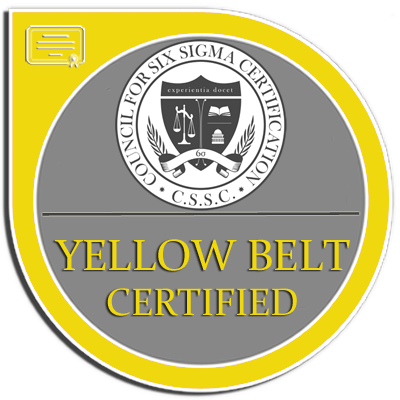
Official Yellow Belt accreditation badge, issued by the Council for Six Sigma Certification.
This is to certify that
has successfully completed all requirements for
Six Sigma Yellow Belt Certification
Trainers


Applied in these industries
What learners say
“Great learning experience with Anurag Sir. His teaching style is very practical and easy to understand. He explains Six Sigma concepts with real-world examples, which makes the sessions very interesting and useful.”
“Anurag sir has a good experience and knows how to explain things with good examples that we can relate to from our daily life. It was a really wonderful session of Six Sigma BB+AI Training.”
“The Quality Management Trainer Mr Anurag Jain program was conducted very well. The sessions were clear, practical, and highly informative. It enhanced our understanding of quality standards and real-time implementation.”
Frequently asked questions
What's the difference between White Belt and Yellow Belt?
White Belt teaches vocabulary and awareness only. Yellow Belt adds practical tools, process mapping, data collection, and basic root-cause analysis, so you can actively do project work, not just understand it.
Do I need Yellow Belt before Green Belt?
It's not a strict prerequisite, but it helps. Yellow Belt's process-mapping and root-cause tools are foundational to Green Belt's statistical curriculum, so it makes Green Belt easier to absorb.
What's included in the Yellow Belt fee?
Live instructor-led training for all 16 hours, templates for SIPOC/fishbone/data-collection tools, practice datasets, and your named CSSC-recognised certificate on completion.
What languages is Yellow Belt taught in?
English, Hindi or Hinglish, tell us your preference when you enquire and we'll confirm a batch for it.
How soon do I get my certificate after finishing?
The same day you complete the course, delivered digitally as a PDF, print-ready, with a unique certificate ID you can share with employers.
Is Yellow Belt self-paced or recorded?
No. Every SigmaCS batch, live online, classroom or on-site, is delivered live by an instructor, there's no self-paced or pre-recorded track.
Do you offer EMI or corporate group pricing?
Ask when you enquire, individual EMI options and corporate group rates (5+ participants) are handled case by case rather than published as a fixed plan.
What job roles typically hold a Yellow Belt?
Team members and analysts who actively contribute to DMAIC projects, collecting data, mapping processes, running root-cause sessions, without formally leading the project themselves.
Related reading
Related courses
Six Sigma White Belt
Six Sigma White Belt is a no-prerequisite, half-day introduction to Six Sigma vocabulary and the DMAIC framework, for anyone who needs to understand improvement projects without leading one.
4 hrs · ₹500
Six Sigma Green Belt
Six Sigma Green Belt trains you to lead a DMAIC improvement project part-time alongside your regular job, using statistical analysis, hypothesis testing and process capability studies.
40 hrs · ₹16,000